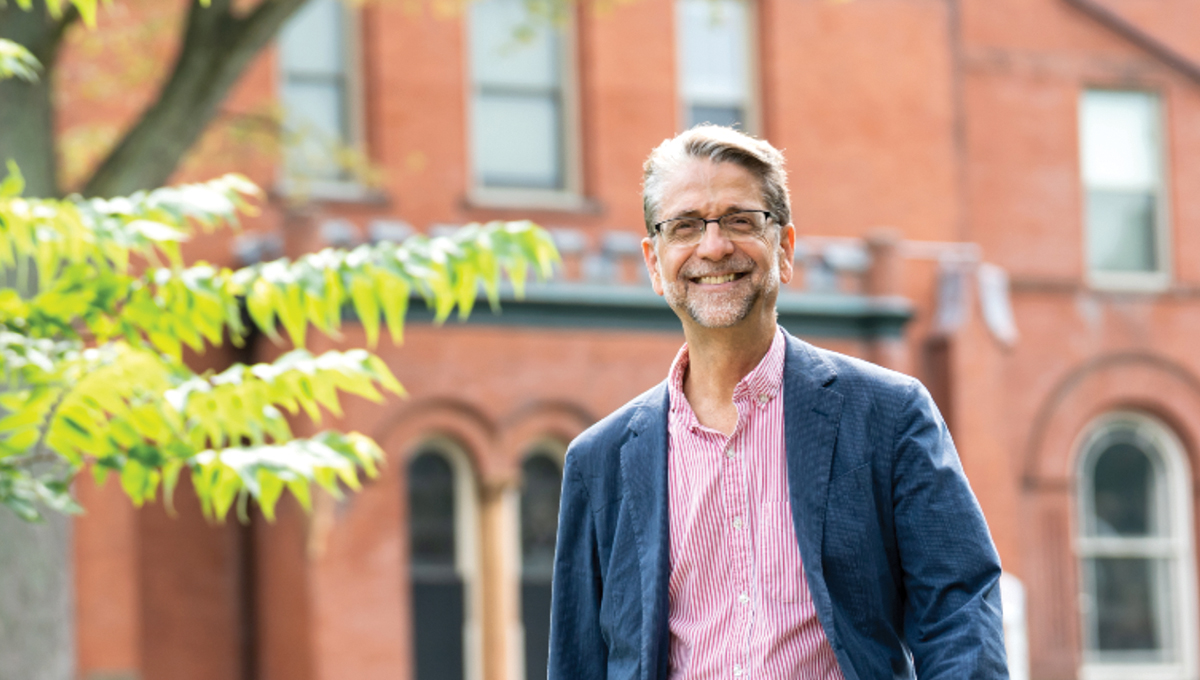
Description: Ephraim Radner at Wycliffe College, Toronto.
Ephraim Radner, professor emeritus of historical theology at Wycliffe College in Toronto, is author of A Time to Keep: Theology, Mortality, and the Shape of a Human Life (Baylor, 2016). An Anglican cleric, he has served as a missionary in Burundi and Haiti, and taught and pastored in the United States. He spoke with Faith Today’s Bill Fledderus about death and birth, and why he views it as essential for Christians to oppose medically assisted dying.
Faith Today: Some Christians argue helping someone end their life can be a loving thing to do. Can you help us make sense of the different approaches to this topic?
Ephraim Radner: One of the reasons this topic is difficult is that the culture of our day has pulled apart the whole character of death from what it means to be a human being.
Dying is actually not its own distinct thing – it is better to understand it as a part of existing. All of us are dying. We cannot escape death; that’s part of who we are. Death and birth go together. Death and birth represent two aspects of what it means to be created without our say-so. We are born without asking for it. God gives life to us and takes our life without asking for it.
It doesn’t matter whether we’re 10 or 30 or 80 or 100 – it’s a pretty short life one way or the other. But the big intrusion is not that we die. The big intrusion would be taking life away with our own hands – either from others (killing) or from ourselves (which is suicide). And I want to be clear that medical assistance in dying is suicide or murder. It’s both. It’s not something different.
Life is ultimately a gift. When we say no to that gift we’re not just saying no to suffering, we’re saying no to everything that’s part of our life.
The only way to understand who we are as a gift in this natality-mortality matrix is to look at who the fulfilled gift is. That is Jesus Christ. That is God’s own gift of Himself.
There’s that [time] in the garden where He looks at the fact He is going to die – die in a certain way, the Passion, the Cross. He says, “Father, let this cup pass from me”; and then He says, “Not my will, but thy will be done.” As we pray in the Lord’s Prayer, “Thy will be done.”
FT: So we should follow the example of Jesus in enduring suffering, seeing it as part of living in God’s will? And choosing suicide is an act of not following Jesus?
ER: The motivation for suicide for many people is pain, whether it’s physical pain, or mental or emotional pain. Once we reach a point we call intolerable, we take our existence into our own hands and we kill ourselves or we have someone kill us.
Now why would it be wrong to end someone’s pain?
Let’s get some historical perspective here. Laws about suicide were not enacted until the early Middle Ages, but even with early Christians it’s clear that suicide, although it’s understood as being something somebody might want, is rejected as something that a Christian would embrace.
There were laws that penalized suicide saying, for example, that people who committed suicide couldn’t be buried in certain cemeteries. But it turns out in fact that such penalties were rarely used because they didn’t apply to people who killed themselves in “unsound mind in a fit of madness.” Most people tried to fudge that. Most pastors and magistrates and so on gave the benefit of the doubt to unsoundness of mind.
But why have penalties at all then? They were aimed at public example. Our ancestors did not want to encourage people to think taking their deaths and thus their existences into their own hands was permissible.
And we’ve seen this already in Canada, that the whole permission of suicide, whether for the terminally ill or people in intolerable physical pain, is indeed a slippery slope. First, it’s the elderly and incurable cancers and horrible pain. Next, it’s the, well, gee, it’s intolerable. Intolerable how? Mentally intolerable. It’s depression. It’s anorexia. It’s this and that. Then it’s not just old people, it’s younger people.
Suffering in illness to the end with only palliative care given [is the model Jesus set for us]. What does it mean for older people suffering to their deaths and accepting not to kill themselves, but to go through the dying process as best they can?
A good death is a gift. Older people offer to younger people the courageous example of suffering without killing themselves, with offering to God their suffering, with joining Jesus in His suffering.
Take that away and the whole gift of the Christian discipleship is thrown into the gutter. I’m convinced of that.
It’s not a question of not having compassion on those who kill themselves. But we try to prevent it.
FT: So we shouldn’t sanction it as a society because it’s sending the wrong message?
ER: The deepest, most profound wrong message. It’s not just an error. It’s the message that God has not created us and life is not His. That’s the message.
FT: I’ve heard the most common reason for people choosing MAiD is isolation where their suffering is not seen in the context of being cared for. Some of us don’t have someone to care for us or we feel that caring is too much of a burden on other people.
ER: Excellent point. None of us really live as isolated individuals. We come from parents, we’re raised with other people, but somehow we’ve gotten to this place where often at the times of weakness we’re alone, and we’re not bound to the people that we helped and that now are there to help us.
And that kind of mutual care is the place where, I think you’re implying rightly, suffering finds its meaning.
FT: I hear a kind of radical anti-individualism in your words. It makes me think of a letter from a reader who wrote to us, “End-of-life care involves being supportive of a patient exercising their own moral agency, not adding pressures with language that only one option is acceptable to God. In my view that is spiritual abuse.”
So you would disagree with this letter writer because we shouldn’t be thinking of ourselves in that kind of isolated way?
ER: Bullseye. The notion of human autonomous agency in the face of the gift of our life is a contradiction in terms.
You know, Jesus didn’t commit suicide. People have said, “He went to the Cross. He knew what was going to happen. So it was a form of suicide.” This is not true. At every point along the way it was possible for repentance to take place, whether it was on the part of those who arrested Him or tried Him, or those who finally killed Him. He did not kill Himself. He allowed Himself to be delivered up.
That’s martyrdom, and we’ve had this whole issue of whether martyrdom is really suicide. The early Church made clear you are not to put yourself in a position where you are deliberately getting yourself killed. That would be suicide.
FT: Jesus had opportunities to dull the pain offered to Him or perhaps to shorten the span of the suffering, but He never chose those actions.
ER: It is a mystery. Why would suffering be a part of this gift? Why would anyone say it’s a gift when it’s filled with such pain?
I don’t think suffering is the issue. Harm is the issue in our ethical decision making. We are (it’s the mystery of the Christian life) called into a place where we join with the suffering of the Son of God. And in that we see light and the fullness of what that gift is.
And it goes back, it’s lodged at the heart of Scripture. Job is the main place where, if you will, it’s crystallized. “Naked I came into the world, naked I go out of the world. Blessed be God,” he says. I think the longest commentary of John Calvin is on the book of Job – over a thousand pages. For centuries Christians were deeply sympathetic with Job’s suffering and with his wife saying, “Why don’t you just curse God and die?”
They understood that somehow Job was allowed to live into the profound mystery of God’s creation of his own existence, which included suffering. And in living into it fully, to seeing who God is in a kind of astonishing light.
You can’t do that from the outside. You can only do that from the inside, which is why, of course, older people need to help younger people understand that’s a possibility, an invitation, a gift, rather than saying, you know, “This is too much. Kill me.”
I think it’s an abrogation of the deepest Christian responsibility for older people to accept their own termination. I hate to say that. I have several good friends where there has been assisted suicide in their family. I don’t judge them. I don’t want to judge them. I do want to say they’re wrong. I’m not judging their moral motivations and the reasons they’re doing that, but I am judging the rightness of their choice in the end.
FT: You’ve made a strong case for this Christian perspective. But we’re living in a country where so few people are Christians. What do we as Christians do then if we hold to these kinds of beliefs?
ER: Well, we’ll start with churches. We at least have to be clear suicide and assisting others, killing them, is unacceptable for the Christian. We have to teach that. We have to start with clarity about all the things we’ve just been talking about. We have to talk about it, we have to teach about it, pastors have to be educated about it and so on.
Then in a multicultural society we have to do our part to oppose legislation that expands it and roll it back. I’m not a big political activist, but there are some things you do have to stand against. This is one of them.
FT: You’ve worked in Burundi and Haiti, and in parts of the United States as a pastor. Does this kind of struggle work out the same way in all those places?
ER: It’s helpful to bring that up. Some worldviews can accept suicide, others can reject it. The Christian challenge is this integrated understanding of the gift of our creatureliness from God which is given in perfected form in Jesus Christ. And we’re not there yet. That’s our imperative and our calling as Christians, whatever culture we’re in.
FT: Could you end with some encouragement for our audience?
ER: Yeah, I want to be a little confessional, and hopefully in the end encouraging, because I don’t want anybody to think I’m some kind of extremist who has a doctrinaire view about the nature of life, and it doesn’t matter what anybody goes through.
I don’t know, except in very limited personal ways, what intolerable physical pain is like. I’ve seen it, so I admit that limitation. But I do know what intolerable emotional pain is like. My mother committed suicide when I was an older teenager. My sister committed suicide. When I was 20, after my mother’s death, I made an attempt on my own life. I could go on. I don’t want to go on because I don’t want to violate confidences.
It’s been hard to know how to live in a world where the people I love the most, trust the most, who have shaped me the most, have at some point decided their lives were not worth it any longer. Not worth it. Not just that they were ready to die, but not worth living to the extent they could. And I’ve had to fight against that example just in order to survive.
And by the grace of God, I’ve learned to be compassionate toward the reasons people find life intolerable. I’ve seen a lot in my pastoring, not just in my own experience.
Life is a struggle. But I’ve learned how worth it life is. It’s beautiful. In all of its depth and darkness, the light is greater because of who God is, who has given me this life and shown me what this life truly is, and offered a way into it in Jesus Christ. I know that.
This is not just some kind of conceptual, theological edifice that I have insisted upon. It’s a living habitation which is filled with grace. I want people, my children, my students, I want the people I live with in church and meet in the supermarket to understand that as well.
FT: Thank you, Ephraim.
Listen to Bill Fledderus’ full interview with Ephraim Radner at FaithToday.ca/Radner. TAP
This interview first appeared in the November/December 2023 issue of Faith Today and is reprinted with permission of both the magazine and Dr. Radner.

IN THE GOSPEL LESSON for this first Sunday in Lent, we have Saint Matthew’s account of the temptations of Jesus. This lesson is clearly intended to establish in our minds the meaning and the message of the Lenten season, and we should examine it with careful attention. And perhaps before we do that, it would be useful to think for a moment about the background and context of the story.
continue reading
According to Jonathan Haidt’s and Greg Lukianoff’s book The Coddling of the American Mind, the spike in anxiety and depression is also related to “Great Untruths” that have spread across our culture, but are especially powerful among current college students born 1995 or later – Generation Z and Generation Alpha. These “Untruths” relate to Fragility, Emotional Reasoning and an Us vs. Them understanding of the world. Haidt and Lukianoff may be on to something.
continue reading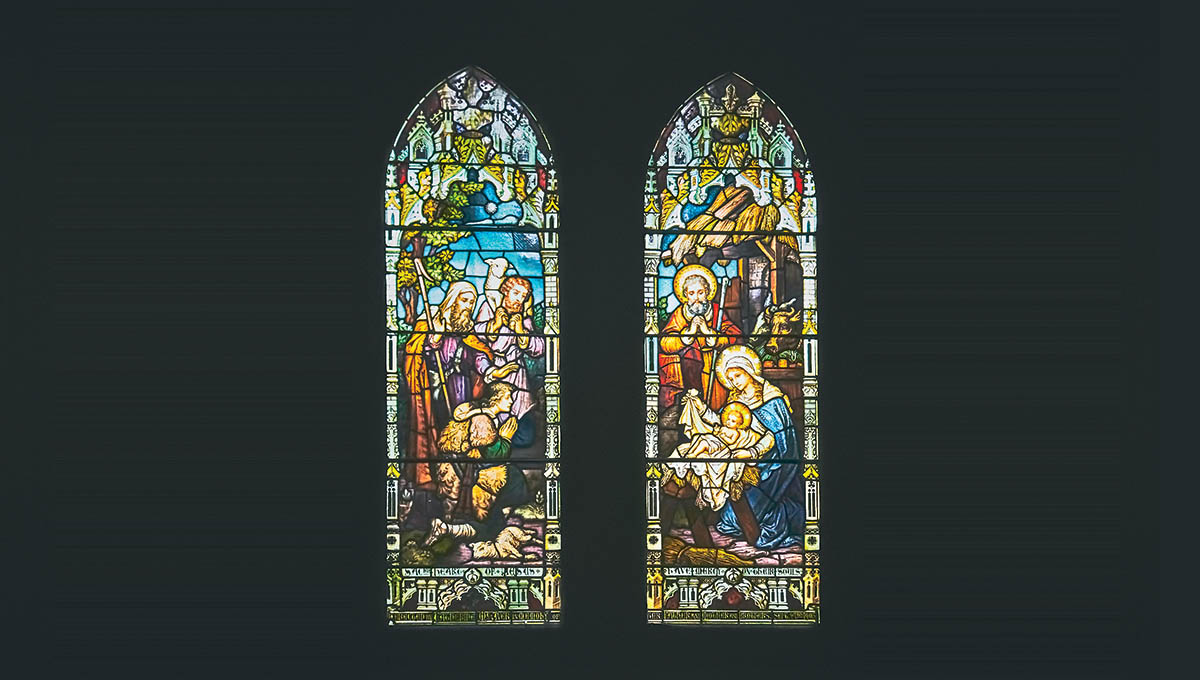
HAVE YOU EVER been envious of the shepherds that first Christmas night – when they had all those angels speaking to them, telling them about God – or felt how wonderful it would have been to be Mary and have God speak directly to you about his plans for your life?
continue reading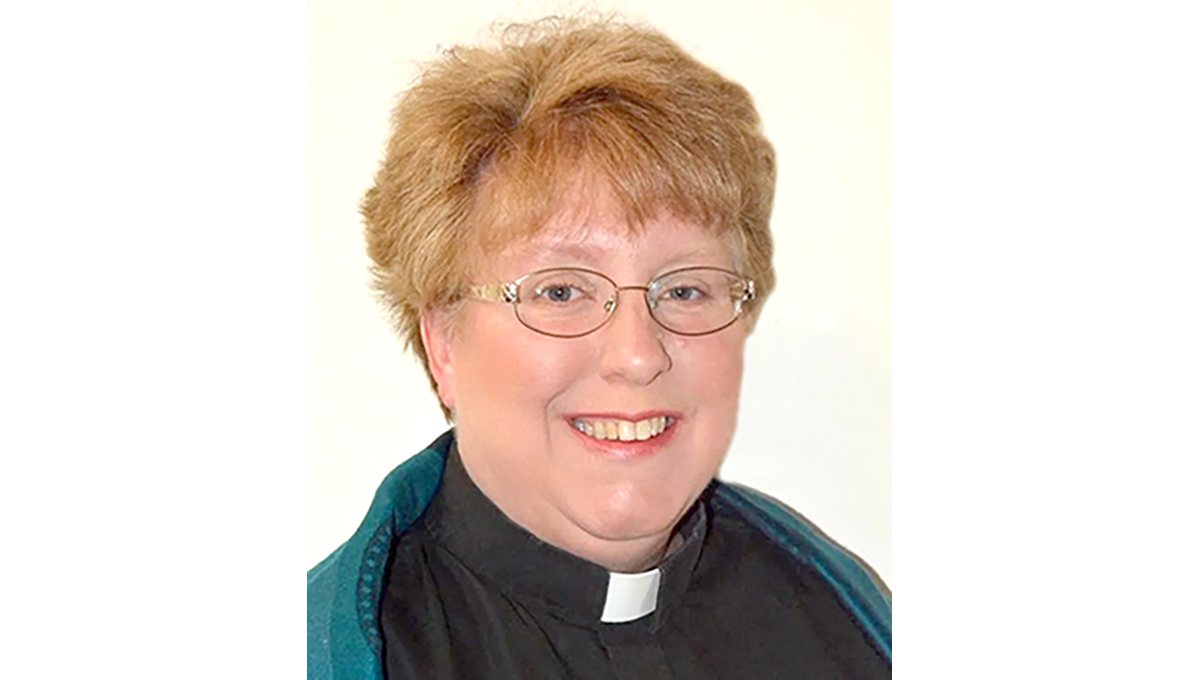
THE DIOCESE OF BRANDON has a new bishop-elect. On Nov. 25th the Ven. Rachael Parker was chosen on the second ballot by 21 clergy and 28 laity. She succeeds Bp Willliam Cliff who served the diocese for seven years from 2016–2023 and who is now Bishop of Ontario

(Staff) HEALTH Minister Mark Holland says Canada is not ready to expand eligibility for assisted death to people whose only medical condition is a mental illness.
He said the Liberal government agrees with the conclusion of a joint parliamentary committee report, released on Jan. 29, that more time is needed before such an expansion can happen. The report concluded that fundamental issues around the expansion have not yet been resolved.
_Cropped copy.jpg)
THE NEW Testament word for hospitality philo-xenia is a wonderful concept because it means the love of the xenia, the foreigner, the outsider. It’s a far more daring concept than friendship philia, which is the love of your own kind, your kindred. Philo-xenia is the fruit and mirror of the gospel, where God welcomes us, the outsider, the foreigner
Ephraim Radner, professor emeritus of historical theology at Wycliffe College in Toronto, is author of A Time to Keep: Theology, Mortality, and the Shape of a Human Life (Baylor, 2016). An Anglican cleric, he has served as a missionary in Burundi and Haiti, and taught and pastored in the United States. He spoke with Faith Today’s Bill Fledderus about death and birth, and why he views it as essential for Christians to oppose medically assisted dying.
Copyright © 2024 The Anglican Planet. All rights reserved